
Sex Offender Checks in Clayton County
The Iowa Sex Offender Registry is the main public search channel for Clayton County. Iowa DPS and its Division of Criminal Investigation maintain the statewide system. A user must accept its terms before searching. The portal can be filtered to Clayton County, a city, a ZIP code, a name, or a geographic area. Telephone and email search paths help check whether those contact details have been registered. Recently updated and most-wanted lists serve different purposes and should not be treated as a list of every person who registers in Clayton County.
The registry says it generally updates hourly on weekdays during business hours, but it warns that the public site does not contain Iowa’s full registrant list. A missing public result is not proof that no registration record exists. The Clayton County Sheriff is the local fallback for relevant information that can lawfully be released. For cross-state questions, the national registry layer can help, while local questions about registration or compliance should go to the sheriff rather than a private search service.
Clayton County Redesigned Registry Search
Iowa DPS launched a redesigned registry on August 22, 2025. The change added broader search paths, interactive maps, and clearer routes to active and most-wanted information. This matters in Clayton County because a searcher is not limited to a surname. A family planning a route near a school can use a place-based search, while someone checking a known identity can use the name controls. Each route still depends on the public data Iowa law permits the agency to post.
The official Iowa registry interface shows how those search choices are presented. The image is an interface view and does not center a private person.
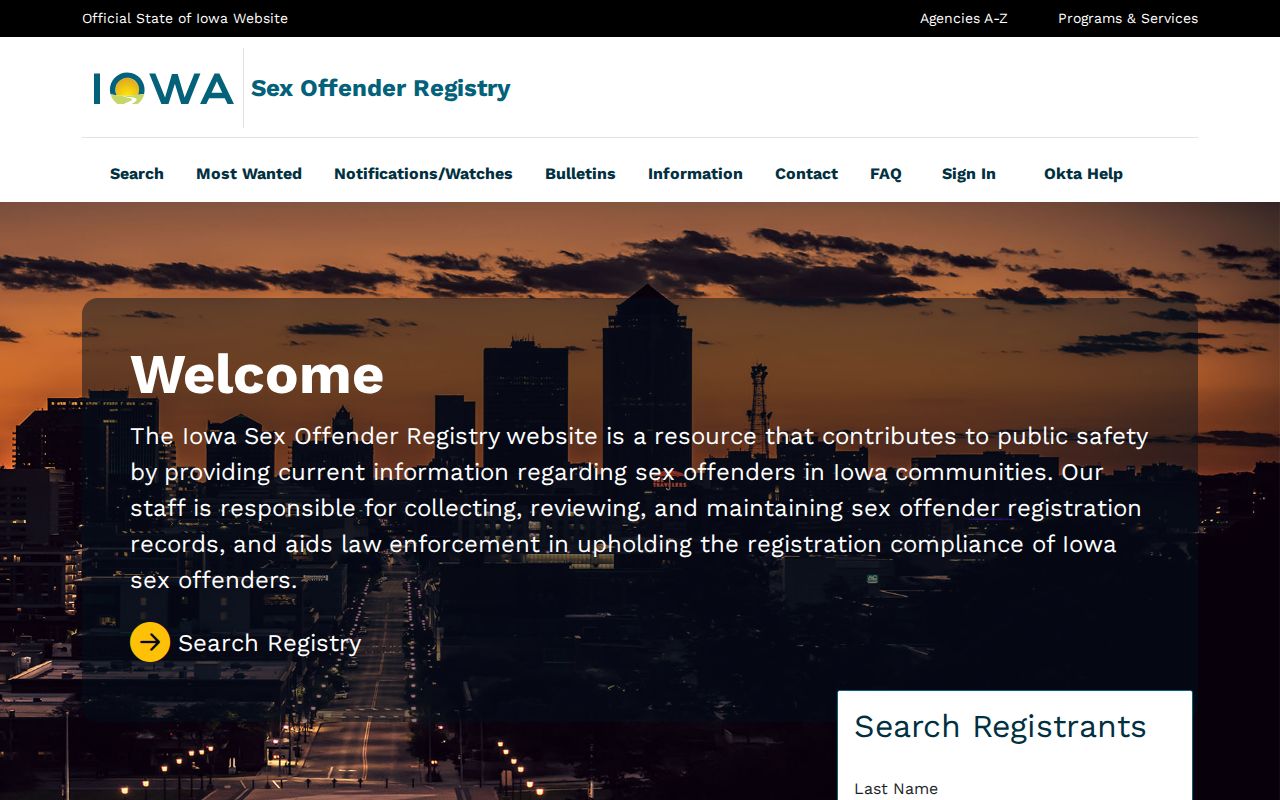
Its tabs separate basic, advanced, map, phone, and email work, which makes the selected search method as important as the terms entered.
How to Search the Iowa Sex Offender Registry
Start with the narrowest verified detail, but do not rely on one fact alone. A name can produce a same-name match. A map can show an approximate location rather than a guaranteed point. City and ZIP boundaries also do not always answer the same geographic question. Clayton County results should be checked against the full public profile, including aliases, photograph, physical description, residence information, registration offense, and status indicators.
- Open the official Iowa registry and read the terms of use before selecting the agreement button.
- Choose a basic, advanced, or map search, then enter a name or select Clayton County, a city, ZIP code, or radius.
- Compare possible results with more than a name. Use aliases, physical details, residence information, and the listed offense to avoid a false match.
- Open the public profile, note its update and restriction fields, and contact the Clayton County Sheriff when local confirmation is needed.
The live controls may change, so the portal’s current labels control. These were the documented paths at the July 22, 2026 research date:
| Search control | Type | Required | Use |
|---|---|---|---|
| Name | Text | Search-dependent | Find a known identity or alias |
| County | Dropdown | No | Select Clayton County |
| City or ZIP | Text or select | No | Narrow a place-based search |
| Geographic radius | Selector | Search-dependent | Search around a mapped place |
| Phone or email | Text or path | For that route | Check registered contact information |
| My Watches | Account tool | Account needed | Manage change notices |
Clayton County Registry Watches
My Account and My Watches add a notification layer to a Clayton County registry check. Iowa’s portal says a watch notice is sent within 60 minutes after a change is made to registered information. That can be useful for ongoing neighborhood awareness because it avoids repeating the same manual place search each day. It does not promise advance notice, real-time officer confirmation, or a complete record of people whose data is not authorized for public display.
A watch should supplement, not replace, a fresh profile review. Read what changed and compare it with the current listing. If an entry appears wrong or a person seems noncompliant, report the concern to law enforcement. Do not investigate, confront, or try to enforce registration rules yourself. The sheriff and Iowa DPS have access to records and procedures that the public page does not show.
Inside a Registry Profile
Iowa Code chapter 692A defines the public internet fields. A Clayton County profile can show enough detail to distinguish one person from another and understand the registration basis. It does not expose every item held by the registry. The public limits protect victims, witnesses, certain youthful-offender information, and sensitive identity records. A listed address or map pin also should not be used as a substitute for lawful local confirmation.
| Name and aliases | Legal name, nicknames, and authorized ethnic or tribal names. |
|---|---|
| Photo and description | Photographs, physical traits, scars, marks, and tattoos used for identity checks. |
| Residence | Public residence information and a best-effort geographic display. |
| Offense | The registration offense, statutory citation, and authorized offense text. |
| Restriction indicators | Whether Iowa residence or exclusion-zone provisions apply. |
| Not displayed | Victim identity, fingerprints, DNA, government ID images, employer or school location, and other unauthorized fields. |
Each public field answers a limited question. It does not provide the motions, plea, judgment, or sentence found in the court case. Readers who need that distinct record can use the contextual route to Clayton County criminal court cases.
Clayton County Registration in Saint Olaf
Registration occurs in person with the sheriff of each Iowa county where a registrant lives, works, or attends school. Iowa Code section 692A.104 uses a five-business-day reporting rule for registration and changes. Temporary lodging beyond five days also creates a duty under section 692A.105. In Clayton County, the local starting point is the Sheriff’s Office and Law Enforcement Center at 22680 230th Street, Saint Olaf, IA 52072. Call 563-245-2422 before a visit to confirm the registration schedule and process.
Clayton County Sheriff
Law Enforcement Center
22680 230th Street
Saint Olaf, IA 52072
563-245-2422
Call before visiting. The published county administrative hours are weekdays from 8:00 a.m. to 4:00 p.m., excluding county holidays.
Iowa law bars a sheriff or police department from charging for a public request for relevant registry information. The sheriff’s current team page identifies the local command, while the Clayton County portal provides the official department route and closure notices. That access rule is separate from the process imposed on a person who must register. Suspected noncompliance should be reported with concrete facts, not posted as an accusation based only on an old map view.
Iowa Registration Levels and Requirements
Iowa tiers mainly set verification frequency. They should not be confused with federal SORNA duration labels. The basic Iowa duration is generally ten years, but statutory triggers can require life registration, time can be tolled during incarceration or noncompliance, and a registry violation adds ten years. A special sentence under section 903B lasts for its term and never less than ten years. Out-of-state registrants follow the longer applicable Iowa or originating-jurisdiction period.
| Iowa classification | Verification | Duration rule |
|---|---|---|
| Tier I | Annual | Generally 10 years, with exceptions and tolling |
| Tier II | Every six months | Generally 10 years, with exceptions and tolling |
| Tier III | Every three months | Generally 10 years, with exceptions and tolling |
| Aggravated, repeat, or qualifying prior offense | Tier frequency | Life under section 692A.106(5) |
| Sexually violent predator | Governing frequency | Life under section 692A.106(6) |
Photo updates occur at least once each year. Because a profile’s tier, duration, and public visibility answer different questions, do not infer one from another.
Clayton County Registry Distance Rules
Iowa Code chapter 692A contains two distance rules that are often mixed up. Section 692A.114 generally restricts a person convicted of an aggravated offense against a minor from living within 2,000 feet of a school or child-care facility, subject to stated exceptions. Section 692A.113 creates 300-foot loitering or exclusion rules at specified places centered on children, also with exceptions. An indicator on a registry profile helps show whether those provisions apply.
A map circle is not a legal survey. The portal disclaims perfect accuracy, timing, and completeness for mapped locations. Property lines, qualifying facilities, an exception, and the person’s actual status can affect the legal result. Questions about a specific Clayton County restriction belong with the sheriff or qualified counsel, not with a visual estimate from the map.
NSOPW Beyond Clayton County
The National Sex Offender Public Website provides a cross-state search of participating public registries. It is useful when a person may have moved outside Iowa or when a search place spans a state line. A Clayton County-only filter cannot answer that broader question. NSOPW remains a gateway to public jurisdiction data, not a replacement for the Iowa registry’s detailed controls or the Clayton County Sheriff’s local role.
The official NSOPW search interface illustrates the wider geographic layer without displaying a selected registrant.
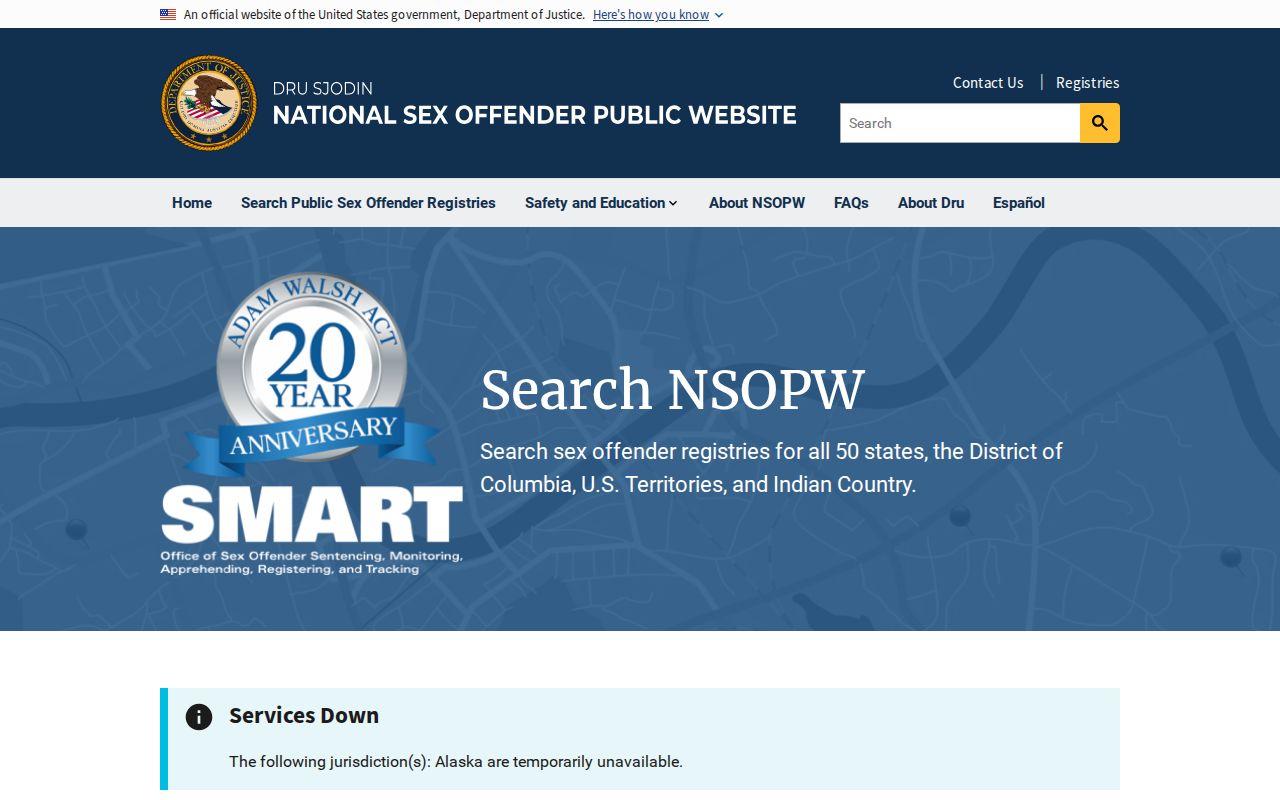
Use it when the likely location is uncertain, then confirm an Iowa result in the Iowa registry and direct local questions to law enforcement.
Note: A national result can still be delayed or limited by the public information supplied by each participating jurisdiction.
Community Notification and Lawful Use
Registry information serves personal, family, and community safety. It can inform a plan, prompt a careful talk with a child, or support awareness of a verified public listing. It does not authorize harassment, threats, vandalism, discrimination, or private enforcement. The portal also forbids automated access outside its official RSS or API methods. A person shown as most wanted or noncompliant should not be approached.
Mandatory misuse warning: The official registry agreement and Iowa Code chapter 692A govern lawful registry use. Vandalism, threats, or assault against registrants, their families, or associated people can lead to arrest and prosecution. Never confront a registrant.
For immediate danger, use emergency services. For a non-emergency Clayton County concern, contact the sheriff. Iowa DPS registry staff can be reached at 515-725-6050 for state-system matters. Give officials the public profile details and the facts observed, without publishing private claims or trying to verify compliance on your own.