
Checking Criminal History in Clayton County
No one database contains the full Clayton County record. Begin with Iowa Courts Online when the goal is to find filed criminal charges, docket events, or a disposition. Select Clayton County and use a case number whenever one is known. A name search is broader, so add a first name and date range, then check the county, party, case type, and docket before treating a result as a match. Former names, hyphens, and spelling changes may require more than one careful search.
The clerk can supply older material, copies, or eligible documents that the public index does not display. Recent custody starts with the Clayton County jail, while an Iowa repository check comes from DCI. Keep the subject's full legal name, exact date of birth, known aliases, incident date, and case or booking number close at hand. Each detail lowers the risk of joining one person's record to another person with the same name.
- Identify whether the needed item is a police report, jail booking, court case, DCI history, or corrections record.
- Search Iowa Courts Online for a filed Clayton County case, using the case number or narrow name criteria.
- Call the clerk at 563-245-2204 when a document, certified copy, or older file is not available online.
- Contact the arresting agency and county jail for a recent arrest or current custody question.
- Order the $15 DCI check when the goal is an official Iowa repository result rather than one county docket.
The official Iowa court interface shown here is the free public index used for Clayton County filed cases.
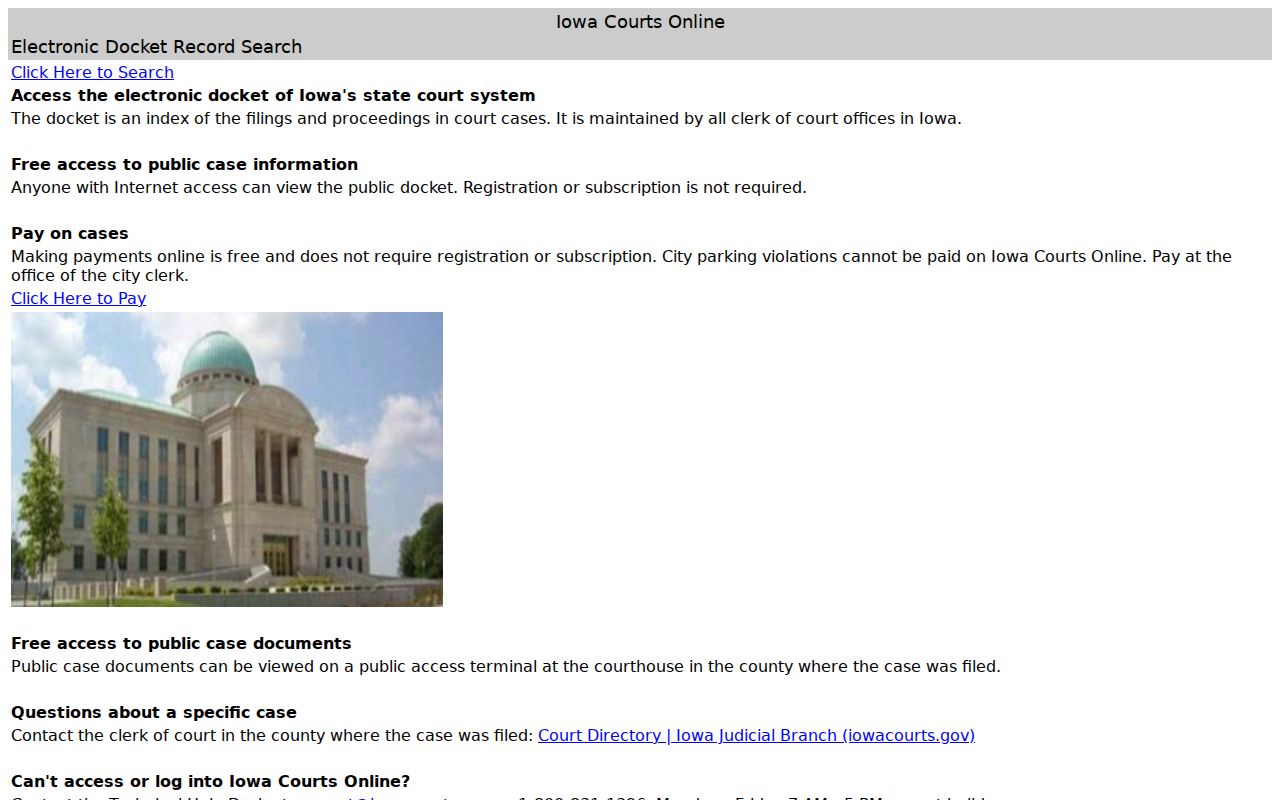
Its index is a starting point, not a certified case file, and some public documents still require the courthouse terminal or clerk.
Clayton County's Three-Stop Record System
Clayton County criminal records are split among Elkader, Saint Olaf, and Des Moines. The Clerk of District Court works from the courthouse at 111 High Street NE in Elkader and keeps the filed case. The sheriff and jail operate from the Law Enforcement Center at 22680 230th Street in Saint Olaf. DCI in Des Moines maintains Iowa's central criminal-history repository. The County Recorder is not the criminal court custodian; its own FAQ directs court questions to the clerk.
That split matters. A city officer may create an incident report, the county jail may create a booking entry, and the clerk may later open a case after the prosecutor files a charge. DCI then receives fingerprint and disposition data through state systems. Timing or an unreported disposition can make the sources disagree for a while. Search the source tied to the question, then confirm across another source when identity or outcome is unclear.
Clerk of District Court
111 High St. NE, Suite 203
Elkader, IA 52043
563-245-2204
Clayton County Sheriff
22680 230th St.
Saint Olaf, IA 52072
563-245-2422
Iowa DCI
215 E. 7th St.
Des Moines, Iowa
515-725-6066
The Clayton County government portal provides the department directory that connects these local offices.
The directory helps a reader avoid sending a court request to the sheriff or a jail request to the recorder.
Iowa Official Background Checks
The Iowa Department of Public Safety, Division of Criminal Investigation is the official state repository. Its Iowa Record Check Online instructions describe a name and exact date-of-birth request. The fee is $15 for each last name searched. First and last name plus exact birth date are the minimum identity inputs. Middle name, gender, and other data may help separate people who share a name.
A signed subject release changes what DCI may disclose. Without one, completed deferred judgments and arrests more than 18 months old without a final disposition are withheld from a non-law-enforcement requester. Juvenile information is generally confidential. For self-review, the subject may use the online, mail, fax, or email route, or appear at DCI in Des Moines with government photo identification for the immediate in-person service described by the agency. DCI takes no phone requests.
Clayton County DCI Check Details
The DCI request and billing forms work as a pair. Both must be submitted, and payment must accompany the request. The state lists online and mail, fax, or email processing as one to three days depending on staffing and volume, while its FAQ gives a general estimate of two to five business days after receipt. A former or hyphenated last name can create another $15 search because the charge applies per last name.
| DCI field | Required | Purpose |
|---|---|---|
| First and last name | Yes | Core name search; fee applies per last name |
| Exact date of birth | Yes | Separates people with similar names |
| Middle name and gender | No | May narrow the identity match |
| Release authorization | Conditional | Expands releasable nonconviction data |
| Requester and delivery data | Yes | Tells DCI where to return the result |
| Card or DCI account | Yes | Supplies the required payment method |
The DCI record-check page pictured here explains the result and release rules that apply statewide, including Clayton County.
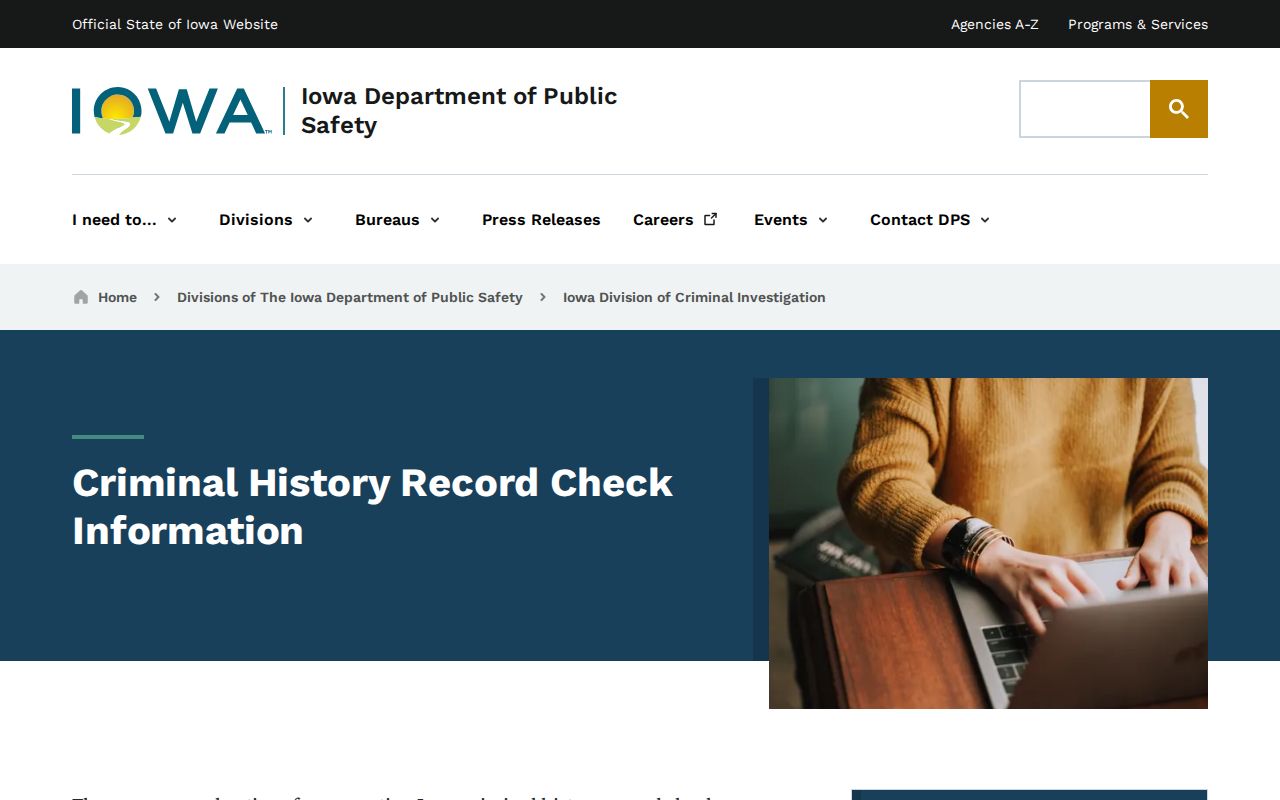
A DCI result is not a copy of the police narrative or every paper filed in the Clayton County court case.
Criminal Record Types
One Clayton County event may create several public records, but each has its own custodian and scope. The incident report records why an officer acted. A jail booking logs intake, custody, bond, and release. The court file tracks the counts a prosecutor actually filed, plus motions, hearings, pleas, judgment, and sentence. A DCI history links releasable arrest and disposition data to an identity under Iowa Code chapter 692.
Warrants, corrections records, and registry profiles add other layers. A warrant directs an arrest and can change from active to served or recalled. ICON covers Iowa DOC custody or public correctional supervision, not a person awaiting trial in the Clayton County jail. The Iowa Sex Offender Registry releases fields authorized under chapter 692A for public safety and carries strict misuse terms.
- Incident or arrest report: held by the sheriff, city police, or other arresting agency.
- Booking record: created by the Clayton County jail for intake and custody.
- Court case file: maintained by the Clerk of District Court after charges are filed.
- DCI criminal history: a state repository product with statutory release limits.
- Corrections or registry entry: maintained by Iowa DOC or Iowa DPS for its distinct public purpose.
Clayton County Jail Record Fallback
No official searchable Clayton County jail roster or public inmate-profile page was found during the official-source review. That does not mean booking records are unavailable. For current custody, call sheriff dispatch at 563-245-2422 and choose option 1. The direct jail information line is 563-245-1540. Ask whether the person is held and what public booking, charge, bond, release, or transfer facts can be given.
Use option 2 on the sheriff line for a booking record or a narrow Iowa Open Records Law request during published weekday administrative hours. Ask the arresting city police department for its own incident narrative. Then search the filed case through Iowa Courts Online and call the clerk if it has not appeared. ICON becomes relevant only after a transfer to Iowa DOC custody or public supervision. A federal transfer instead belongs in the Federal Bureau of Prisons locator.
The official Clayton County sheriff page is the local contact source for jail and booking questions.
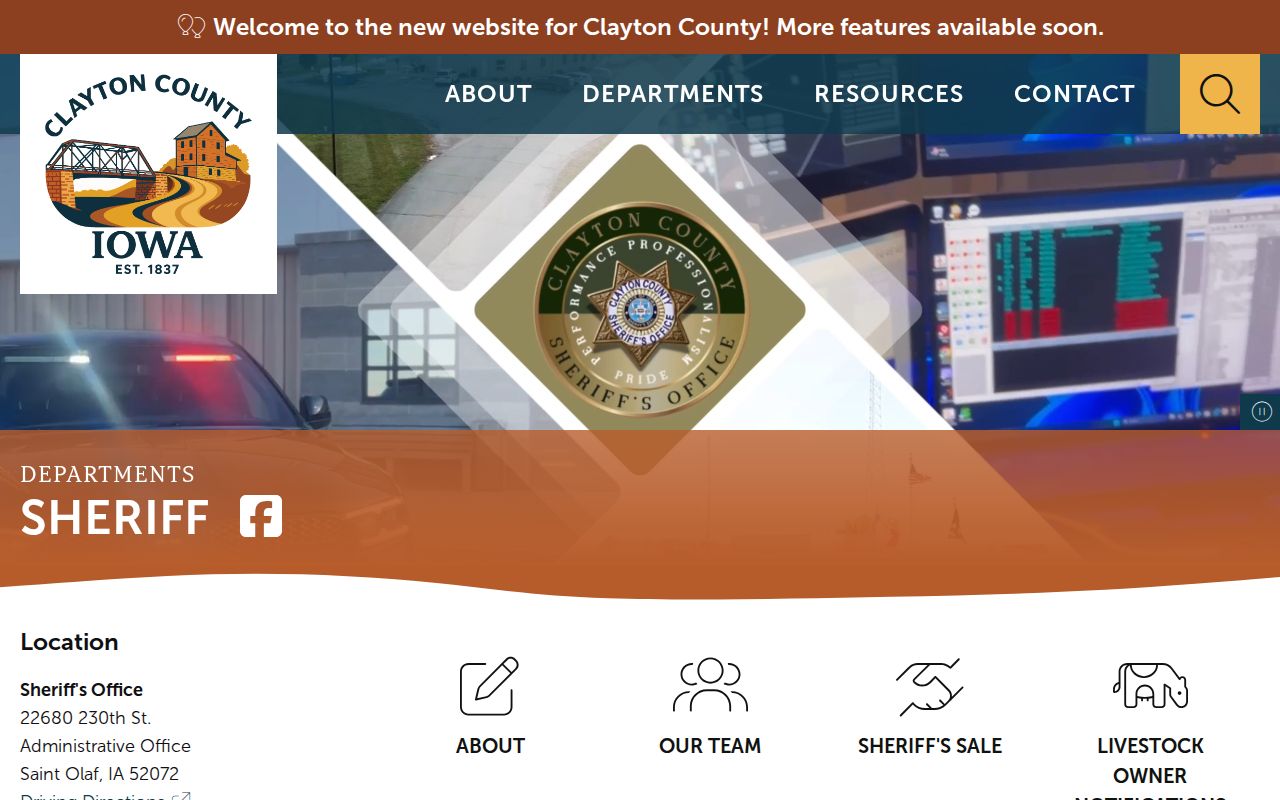
It supports a phone and counter fallback when no public county roster is available.
Note: A booking charge is an intake entry, not proof of guilt or the final count filed in Iowa District Court.
Inside a Clayton County Criminal Record
A Clayton County record must be read in context. Identity fields may include names, aliases, birth information, and descriptive or state identifiers. An arrest cycle can show the agency, arrest date, fingerprint transaction, and arrest charges. The later court or DCI disposition may report a different count and outcome. Within one case, separate counts can end in different ways.
| Name and identifiers | The identity data used to associate the record with a person. |
|---|---|
| Arrest or booking data | Agency, date, intake charge, booking number, bond, and custody events when released. |
| Filed charges | Counts, Iowa Code citations, and offense levels entered in the court case. |
| Disposition | The outcome for each count, which may be conviction, dismissal, acquittal, or another result. |
| Sentence | Custody, probation, financial terms, or other orders entered by the court. |
| Current status | Open or closed case status, release, transfer, or public supervision data from the proper custodian. |
- Arrest charge
- The officer's probable-cause allegation at the arrest stage.
- Filed count
- The formal charge placed in the court case by the prosecutor.
- Disposition
- The recorded legal outcome for one count.
- Deferred judgment
- An Iowa outcome that may later be discharged and may qualify for court-level expungement.
Correcting Clayton County Record Errors
A same-name court result is not enough to confirm identity. Compare the Clayton County designation, case number, filing date, age or birth data when lawfully shown, party details, and original documents. If a docket entry seems wrong or a disposition is missing, contact the Clayton County clerk about the court file. The clerk can explain how to obtain a copy, but cannot change a record merely because a caller disputes it.
For a DCI result, use the agency's accuracy-dispute route. Supply the record details and supporting court material. DCI may request fingerprints to confirm that the challenged cycle belongs to the subject. Missing fingerprints, aliases, data-entry differences, or a disposition not yet reported can cause a county docket and DCI result to diverge. A DCI response of no Iowa criminal history can also mean the data is not legally releasable, not only that no event exists.
Public Access Laws in Iowa
Iowa law treats a sheriff report, court docket, and DCI history as different records. Chapter 22 supplies the general right to examine and copy public records, subject to lawful limits and reasonable fees. Chapter 692 controls dissemination and correction of criminal-history data. Juvenile and investigative information may be restricted, and judiciary access also depends on court rules and sealing orders. Ask for the public portion of a record rather than assuming one confidential part closes the whole file.
Key Statutes:
Iowa Code §§ 22.2 and 22.3 give the public examination and copying rights, with supervision and reasonable fee rules.
Iowa Code § 22.7 lists confidential categories, including limits relevant to investigative material.
Iowa Code §§ 692.2 and 692.3 govern criminal-history dissemination, fees, and redissemination.
Iowa Code § 692.5 provides an access, challenge, and review path for repository data.
Clayton County Sheriff Record Counter
The sheriff does not advertise a separately named records division or a mandatory general request form. Begin with the administrative office at 563-245-2422 option 2. A useful request names the exact item, such as an incident report, booking entry, accident report, dispatch record, 911 audio, warrant information, or fingerprint service. Include the date, approximate time, place, involved name, and report or case number when known.
Requests may start by phone, at the Saint Olaf counter, by mail, or by administrative fax at 563-204-4138. Call before travel because the official site does not promise same-day walk-in copies. Ask for an estimate and for reasonably separable public portions if redaction applies. The county has not published a general report-copy fee, body-camera fee, 911-audio fee, email request address, or guaranteed response time.
| Published sheriff service | Fee | Scope |
|---|---|---|
| Accident report | $5 | Confirm the needed identifying details first |
| Driver's-license check | $10 | Listed service, not a criminal-history check |
| Fingerprinting | $10 | Call about schedule, cards, and identification |
| Prisoner room and board | $50 per day | Capped at $3,000 except specified alternative-sentence cases; not a public-copy charge |
The sheriff's published Civil Division fee page is the source for these local amounts.
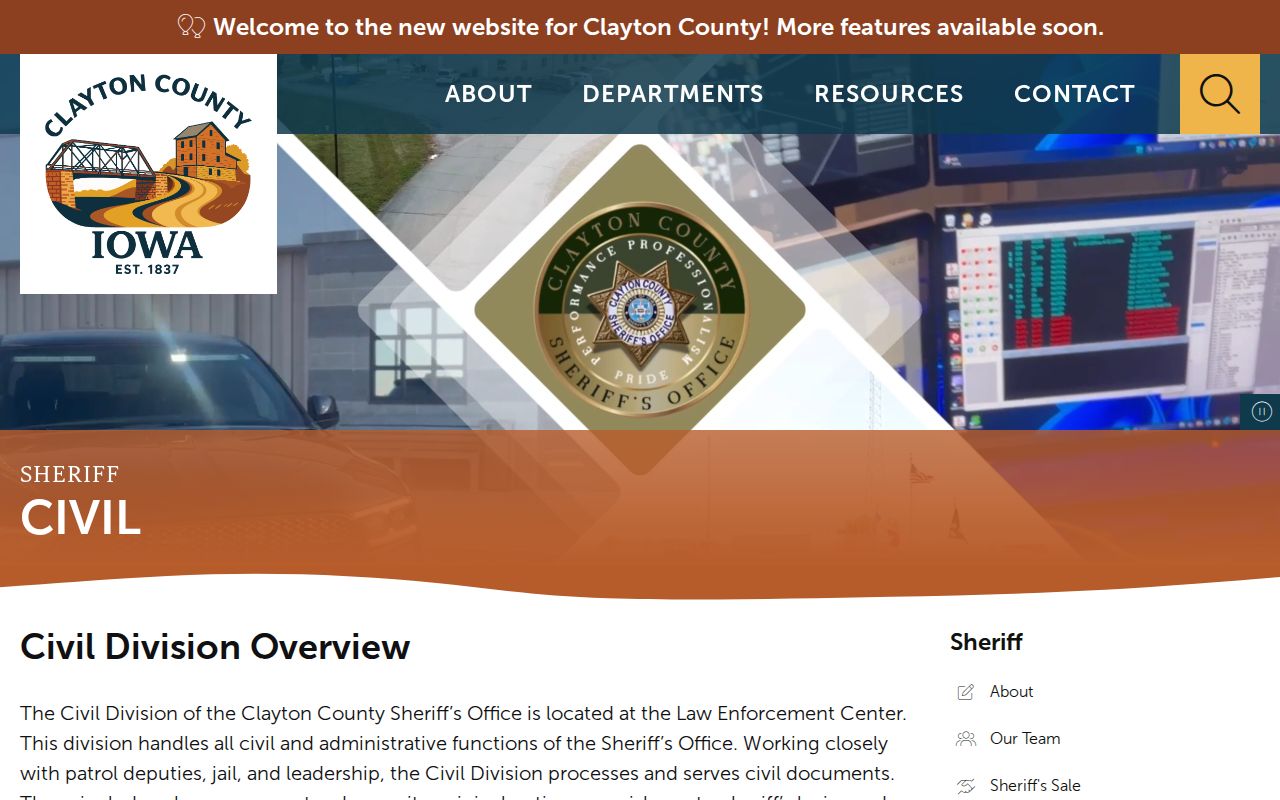
The list is useful, but it does not establish a fee for a product the county has not priced there.
Sealed, Expunged, and Restricted Records
Iowa expungement is tied to a statute and outcome. Chapter 901C covers qualifying acquittals, dismissals, and a limited misdemeanor-conviction route. Iowa Code section 907.9 addresses discharge from a deferred judgment, while other narrow provisions apply to qualifying public-intoxication and OWI matters. There is no single remedy that clears every Iowa conviction.
For a Clayton County case, obtain the case number and disposition, choose the statute and current Iowa Judicial Branch form that fit that outcome, and file through the Clerk of District Court. Ask the clerk about the current fee or waiver process because the research did not locate a Clayton-specific amount. Expungement does not mean no arrest ever occurred. A discharged deferred judgment may leave the public court level while DCI retains a discharged nonconviction notation with its own release rule.
Clayton County Warrant Record Fallback
Clayton County does not publish an official active-warrant database. For a current, safety-sensitive question, call sheriff dispatch at 563-245-2422 option 1. Staff may need identity details or may direct the caller to the court. Iowa Courts Online can show docket entries tied to a warrant, failure to appear, service, or recall, but a new or sealed warrant may not appear.
The clerk at 563-245-2204 is the case-status contact for a Clayton County bench warrant. A city police agency may hold a city-origin record, and a narrow chapter 22 request may reach releasable warrant facts. Do not rely on an old docket line as real-time proof that a warrant remains active. Only the issuing court can recall or quash its warrant. A person resolving a possible warrant should get directions from the court or a lawyer before appearing without notice.
Clayton County Criminal Records by City
Guttenberg, Monona, and Elkader are Clayton County's three largest incorporated cities under the official 2024 population estimates. Their police departments create city incident and arrest reports, but none has a verified separate online arrest log or municipal criminal case portal. A city search starts with the police department, moves to the Clayton County jail for booking, and reaches Iowa Courts Online or the Elkader clerk after a case is filed.
Guttenberg Criminal Records
2024 estimate: 1,804. Start with Guttenberg Police for a city report.
Monona Criminal Records
2024 estimate: 1,462. Confirm the city in Clayton County, not Monona County.
Elkader Criminal Records
2024 estimate: 1,192. City police, court, and prosecutor records sit at separate counters.
Clayton County Probation and Parole Records
Clayton County probation and community-based corrections are organized through Iowa's First Judicial District rather than a separate county probation department. A court docket shows the sentence and probation orders. The First Judicial District Department of Correctional Services handles community supervision across eleven northeast Iowa counties, with programs that include probation, parole, pretrial services, presentence investigations, treatment courts, and residential services.
ICON is the public search route for a person committed to Iowa DOC or shown under public correctional supervision. The Iowa Board of Parole handles parole decisions, while field supervision runs through corrections and community-based services. Iowa Code section 904.602 makes core inmate, parolee, probationer, and related arrest or detention status public, but treatment and security material may remain restricted.
The First District service page shown here identifies the district network that serves Clayton County.
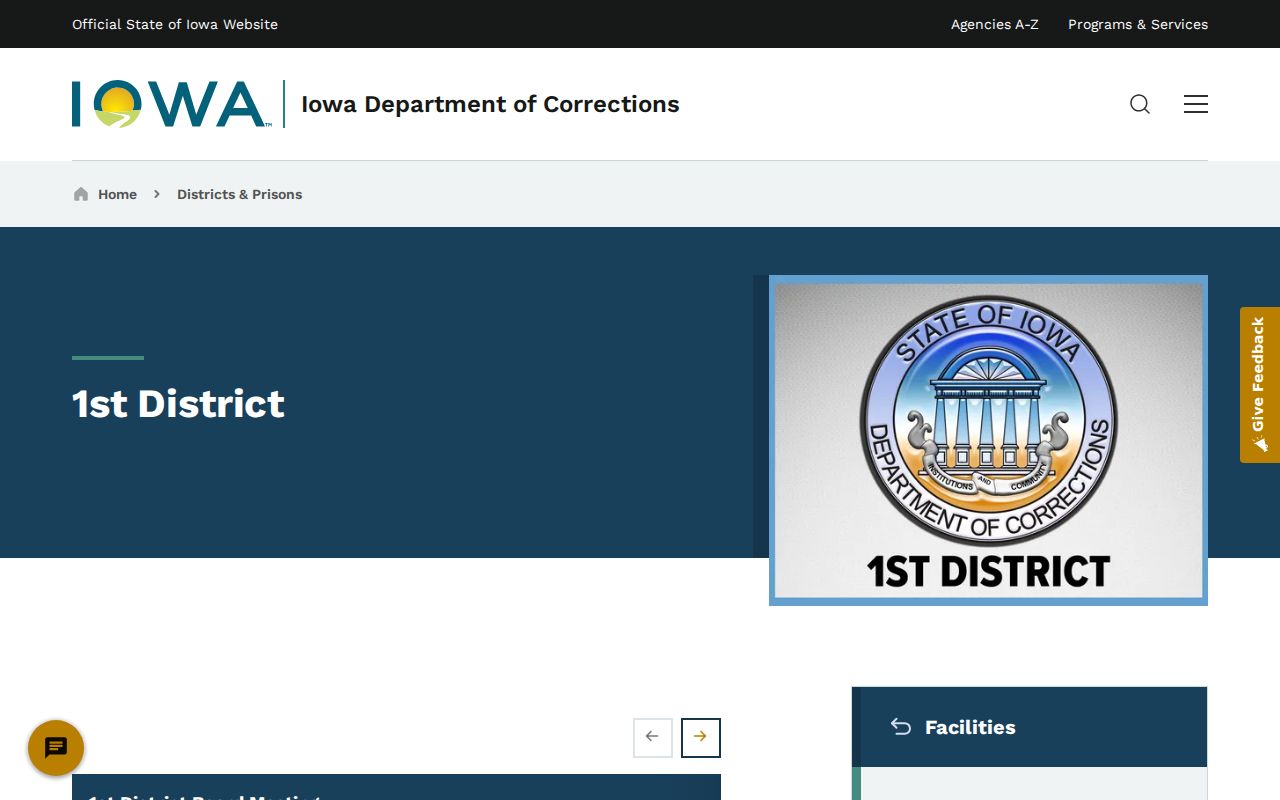
District offices may hold supervision detail that does not appear in a simple county court search.
The Iowa Board of Parole public page is the separate source for parole meetings and decisions.
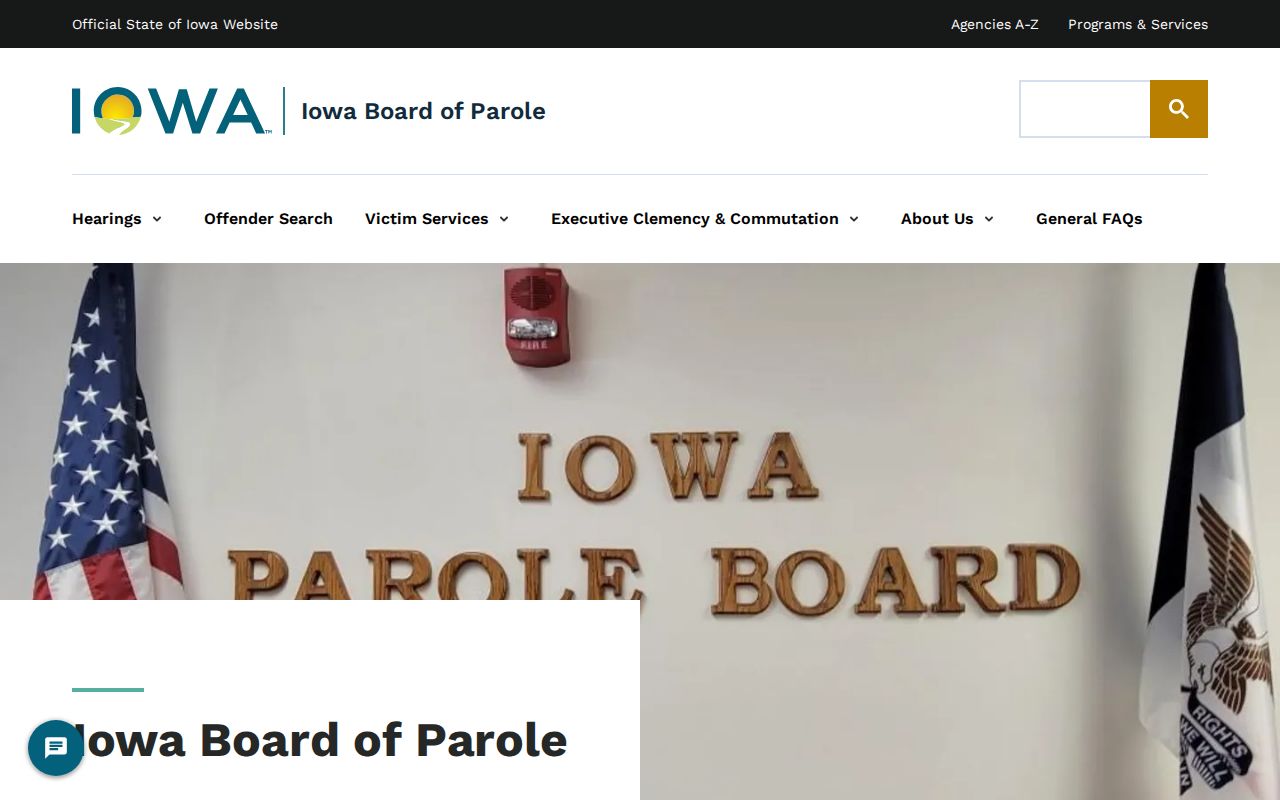
Together, the court docket, ICON, First District, and parole board show different stages of one supervision history.